

RJ-11 is the standard connector utilized on 2-pair (4-wire) telephone wiring. RJ stands for “Registered Jack”- a physical connector interface most often used for telephone wire terminals.
Though the RJ-11 connector has a total of 6 connector positions, typically either only 2 or 4 are actually utilized. RJ-11 connector wiring comes in two standard varieties- untwisted (flat-satin cable) and Unshielded Twisted Pair (UTP).
RJ11 is the most familiar of the registered jacks, due to the fact that virtually all single line (POTS) telephone jacks in most homes and offices in North America and numerous other countries use this connector type.
Other similar Registered Jacks include RJ14 (for a 2-line telephone jack), RJ25 (for a 3-line jack), and RJ61 (for a 4-line telephone jack), all of which utilize 6-position modular connectors.
An RJ11 jack typically utilizes 2 out of the 6 positions, so they can be wired with a 6P2C modular jack (6-position, 2-conductor). However, these types of jacks are very rare. Most often, an RJ11 jack is a 6P4C jack (6-position, 4-conductor), with two of the four wires running to the junction box unused.
The extra wires can be pressed into service for a variety of applications including preventing a pulse-dial telephone from ringing the extension phone bells (an ‘anti-tinkle’ circuit), as a ground for selective ringers, powering an L.E.D. ring-indicator operating off of the ringer signal, etc.
In a powered-up state, Pins #5 (yellow- old color code/orange- new color code) and #2 (black- old color code/white with orange stripe- new color code) may carry either low voltage AC or DC power from a central transformer plugged in near a jack, which supplies power to each of the other jacks throughout a dwelling.
While in most cases, the telephone line directly supplies ample power for most phone terminals.
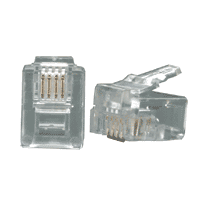
The antiquated telephone terminals contain incandescent lights (i.e. the old Western Electric Princess phone and Trimline phone) and need more energy than the telephone line supplies, as their dial lights need 6.3 volts and the typical transformer output ~5 volts (for long life).
Depending on whether the wire is of the old or new color code convention (read left to right while holding the jack facing you, with contacts pointing upward), the positive and negative terminals are:
- Pin #3- Negative terminal (red- old color code/blue- new color code)
- Pin #4- Positive terminal (green- old color code/white with blue stripe- new color code)
Mohd Abdul Manaf
Hi Sir.. I am just bought Simon Rj11 telephone wall socket… There is number indicator on cover termination which show terminal 3124 in arrangements from left to right.. My old phone cable have white, green and orange wire only .. I would like to know which terminal number need to terminate wire according to color code?For example is it “white-1” or “green-2”..Your help is much appreciated